

Hit the Gong, Beat the Drums
From the first crack of the drum, distinctive, energetic beats signal that a lion dance performance is beginning. What are the instruments behind the music of celebration? How do musicians protect their auspiciousness?

It is said that villagers used to bang on their pots and pans, setting off firecrackers to scare off the fearsome Nian with loud noises. Kitchen utensils gave way to the luogu (锣鼓) percussion ensemble, popularly used in folk music and festivals (Britannica, 2007). Thundering music can be heard far and wide, drawing people’s attention to the festivities taking place, infusing the atmosphere with liveliness.

LUOGU INSTRUMENTS
Three main instruments make up the ensemble: drums, gongs, and cymbals.
Bells, clappers, and woodblocks are sometimes added. The size and instrumentation of ensembles vary. The number of players can range from two to a dozen or more but are always led by the drummer (Britannica, 2007).
Northern Lion Dance focuses on acrobatic jumping and soaring, so smaller, higher-pitched instruments are used to express the fleet-footed lion’s nimbleness. In contrast, Southern Lion Dance tends to use bigger drums and instruments to match the vigour and ferocity of their lions (Chen et al., 2002).
Drums
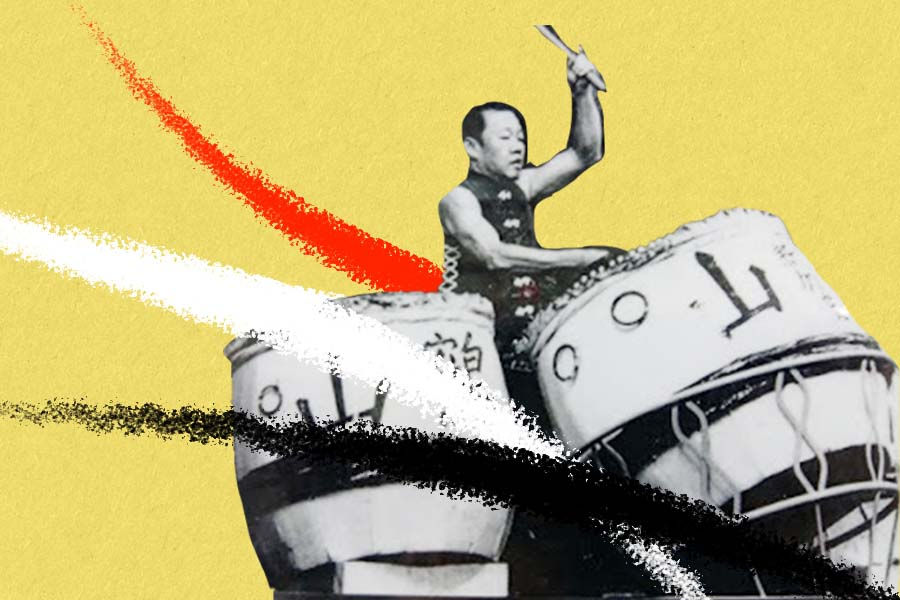
The body of the barrel-shaped drum is made of wood, suspended on a stand. The skins are made of ox-hide, stretched over the openings and pinned to the side. The sides of the drum are decorated based on the troupe’s preferences. It is played with two sticks (Dragon of the South, n.d.).
Cymbals and gongs
These are typically made from brass and tied with rope. Gongs are suspended from a frame and played with a padded mallet, while cymbal players hold one in each hand and clap them together (Dragon of the South, n.d.).
SUPERSTITIONS
Like the dancers, musicians in the Lion Dance troupes also have ‘rules’ to follow to maintain good fortune. The most well-known taboo is to play without reason or rhythm, captured in the phrase: “Don't hit 'empty' drums, gongs, and cymbals" (Guo, 2007).


Drums: The promise of punishment
In the past, large drums known as the tanggu would be hung at the reception hall gates of Chinese officials. It would alert both servants and the public of the official’s arrival, and the opening of hearings (Guo, 2007).
However, the booming drum also became associated with the heavy punishments, corruption, torture, and forced confessions that lay behind the heavy gates. It was commonly believed that you would be punished even before being brought before an official, and to enter the hall meant certain doom. Townspeople rued the day that they themselves might be hauled past the gate and its foreboding drum (Guo, 2007).
The character for ‘empty/void’ (空) can be read the same way as the word for ‘inauspicious/ominous’ (凶).
Cymbals: The call of the dead
The chanting of sutras and other recitations at funerals and death rites are accompanied by the tinny sound of cymbals. To play them without recitations was like alerting the god of death and surrounding spirits to your whereabouts, and they would follow the player home, inviting their own demise (Guo, 2007).
Gongs: The sound of misfortune
Gongs were the alarms of ancient China. It was how villagers would broadcast emergencies like fires, floods, landslides, bandits, and predators—in short, bad news—to the town (Guo, 2007).
Because of their historic uses, to play these instruments void of their intended purpose was akin to looking for trouble. While they have lost much of their original communicative functions, these negative associations have been preserved in superstition and passed down through successive generations of lion dance troupes.


References
Britannica, T. Editors of Encyclopaedia (2007, August 24). Luogu. Encyclopedia Britannica. https://www.britannica.com/art/luogu
Chen, G., Cai, Z., Gao, H., & Wang, J. (2002). Wu shi ji yi huo dong zhi yan jiu [Research on the Skill of Lion Dance]. Sports Administration, Ministry of Education, Taiwan.
Dragon of the South. (n.d.). Instruments. http://www.dragonofthesouth.co.uk/ instruments%20info.html
Guo, W. (2007). Wu shi de yi shu [The Art of Lion Dance]. GigaMedia.
Las Vegas Kung Fu Academy Lion Dance Team. (2011, August 13). Hok San Lion Dance Drumming [Video]. Youtube. https://www.youtube.com/watch?t=4&v=trE8zfBnrNg

Comments