

The Beginning of the Legendary Lion
Updated: Feb 10, 2021
Herein is the soul of the lion, the history and origin of the dance, and the technical skills in becoming a troupe member.

About the Lion

The Lion is the Animal King. It's not as fierce as we imagine, even though it's bold and courageous. It is benevolent and tame, though it looks strong and heavy. Its heroic outlook makes other species fearful (Beyond the Dance, 2013).

According to the history of the lion dance, the characteristics of the lion have been respected and impressed by the Chinese for thousands of years.
In the Chinese epic, its status is equivalent to the symbolic tiger, Phoenix and Qi Lin (麒麟).
The Lion Dance

Lion dancing began in the late Han Dynasty (206 BC - 220 AD).
Due to the Silk Road to China, His Majesty Han Wu Di developed commercial relations with the West.
Cultural exchanges, such as dances and songs were then conducted by functions in the palace to greet visitors from the West (History of the Lion Dance, 2013).
In order to achieve the proper trade with Silk Road traders, these lions were transported from Central Asia to Northern China as presents for the emperor.

During the Three Kingdoms Period (220 AD - 280 AD), when these lions were first introduced, people made fun of their appearance and behaviour during the performance. However, it started gaining popularity with the rise of Buddhism in the Northern and Southern Dynasties (420 AD - 589 AD ).
As time passed, more people started enjoying Lion dance performances. Thus Lion dance started becoming one of the court dances in the Tang Dynasty (618 AD – 907 AD) (Cindy, 2021).
The Myths
After knowing how the Lion and Lion dance was introduced, are you now curious why the Lion dance performances have often been seen outside performance stages? And How did Lion dance become a performance for celebratory events?
To start off, there are many different mythologies in China that resulted in the Lion dances we see today. Now we will be looking at the 2 most famous versions of the lion's story:
Myth 1: Lion dance was able to drive away evil spirits.
This springtime tale begins with the "Nian" (年).

A fearsome beast known as the Nian would seclude itself in a dark sea for long stretches of time. But at the end of the lunar year, the Nian would go onshore to hunt people and livestock.
It would terrorize villagers, attacking the village and destroying their crops in the middle of the night. When this happened, the villagers would escape by hiding in deserted mountains to avoid the Nian's attack.
One New Year's Eve night, a silver-headed old man with brightly lit eyes entered the village. He was dressed in rags and supported himself with a stick. As all the villagers were in a panic at the impending arrival of the Nian, they were preparing to flee (Travel China Guide, 2018).

In that chaotic moment, a granny from the eastern village saw the old man and offered him some food. She told him all about the Nian and convinced him to leave the village and hide in the mountains with everyone. Instead of agreeing, the old man told the granny that he was able to expel Nian away if she let him stay at her house for one night.
Doubting the old man, the granny was not convinced and escaped into the mountains alone.
At midnight, Nian broke into the village once again. Usually, the village was in darkness. But this time, Nian noticed that the house in the east was brightly lit with candle lights and the doors and windows were decorated with red papers. Additionally, the old man was seen to be dressed in a red gown, roaring with laughter with a loud cracking sound (Travel China Guide, 2018).

As soon as Nian was heard the loud noises and saw the brightly lit home, it started to tremble. This time, it was the Nian who fled back to whence it came.
When the villagers returned to their village the next day, they were surprised by the undamaged scene.
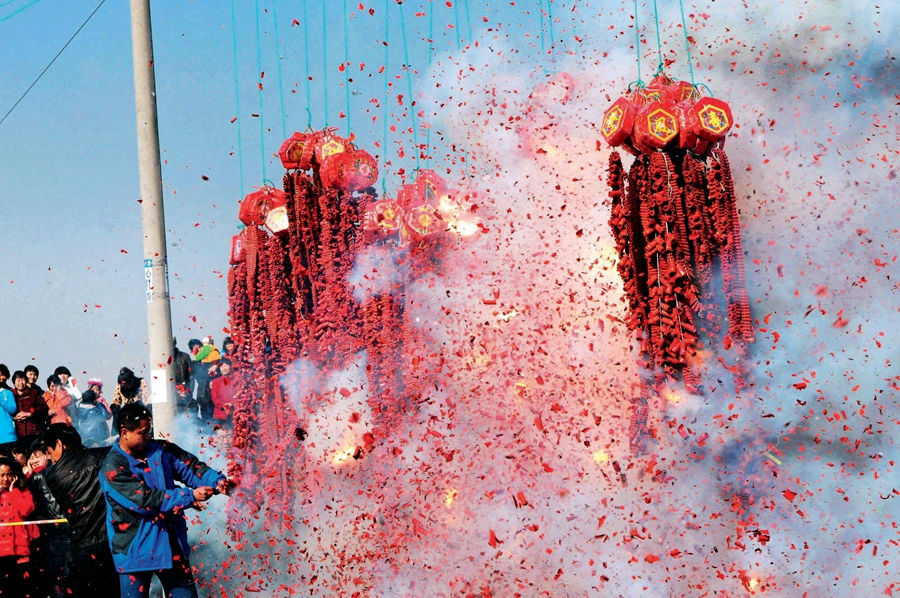
They later found out that the burning cracking of bamboo, the colour red, and bright lights were the way to scare the Nian away (Travel China Guide, 2018).
Ever since, on every New Year's Eve, villagers would build a fierce-looking and brightly red colored mask and costume that resembles a lion together with loud noises or beating pots and pans, waving towards the Nian to frighten it away.
The performance has been reenacted annually on Lunar New Year, symbolizing happiness, success and good fortune.
Mythology 2: The Red Sash on the Lion symbolizes Positive life energy.
During the Tang dynasty, the Emperor said that there was an odd-looking creature, a creature he had never seen, that saved his life in a dream.
Nobody had an answer, except for one of his ministers. According to the minister, the odd-looking creature was said to be a lion. At the time, there were none in China.
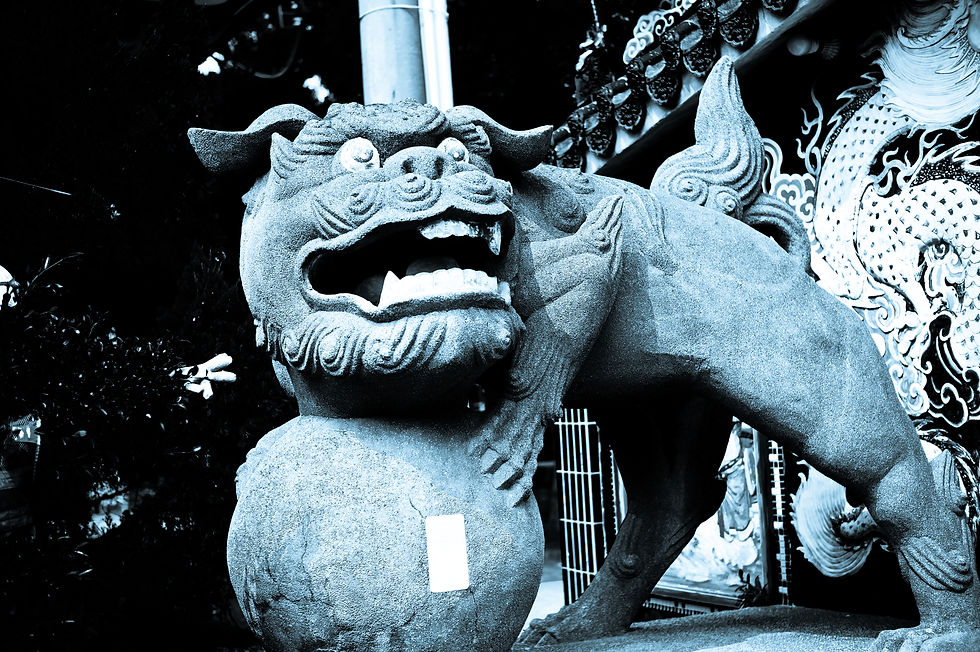
The emperor felt that his dream had messages of good omen, so he decided to construct a model lion.
Born again lion: The mythical lion who lived in heaven has a fondness for practical jokes. One day the lion's behaviour angered the Jade Emperor.
The Jade Emperor then killed the lion and tossed out its detached head and body to rot. Feeling pity and merciful, Goddess Kwan Yin, the Goddess of Mercy, re-attached the lion's head and body with a red sash and gave the lion life again on condition that it will do acts of goodwill (ACA Lion Dance, n.d.).
Today, the red sash is seen on the lion head and it symbolizes positive life energy, Yang energy (Yin, which is negative energy). Goddess Kwan Yin also attached in the front of the lion's forehead a unicorn horn and a reflective object i.e. mirror which is believed to bring good fortune and drive away evil spirits (ACA Lion Dance, n.d.).


References
ACA Lion Dance. MYTHS: ORIGIN. (n.d.). https://www.uclaliondance.com/culture.html
Beyond the Dance 2013. (2013, June 11). History of the lion dance. https://beyondthedance2013.wordpress.com/dance_history/
Cindy. (2021, February 5). Lion dances at Chinese New Year: Symbolism, origins and styles. China Highlights. https://www.chinahighlights.com/travelguide/special-report/chinese-new-year/new-year-lion-dance.htm
HKCinema. (2020, January 25). Nian (Nian Shou, 2020) chinese fantasy trailer [Video]. Youtube. https://www.youtube.com/watch?v=U81Uapx6R0g
South China Morning Post. (2019, February 4). Lion dancing: good wishes for the Chinese New Year [Video]. YouTube. https://www.youtube.com/watch?v=0eLW0TkK5Jw
Travel China Guide. (2018, December 21). Chinese New Year Story - Legend of Monster Nian. https://www.travelchinaguide.com/essential/holidays/new-year/story.htm
Week in China. (n.d.). W: Wudi of Han [Illustration]. Week in China. https://www.weekinchina.com/chapter/an-a-z-of-chinese-history/wudi-of-han/


Comments